A First Meeting That Makes Room for Useful Introductions
Plan a rural networking meeting that helps neighbors share skills, find relevant contacts, and choose a next step without pressure or surprise contact lists.
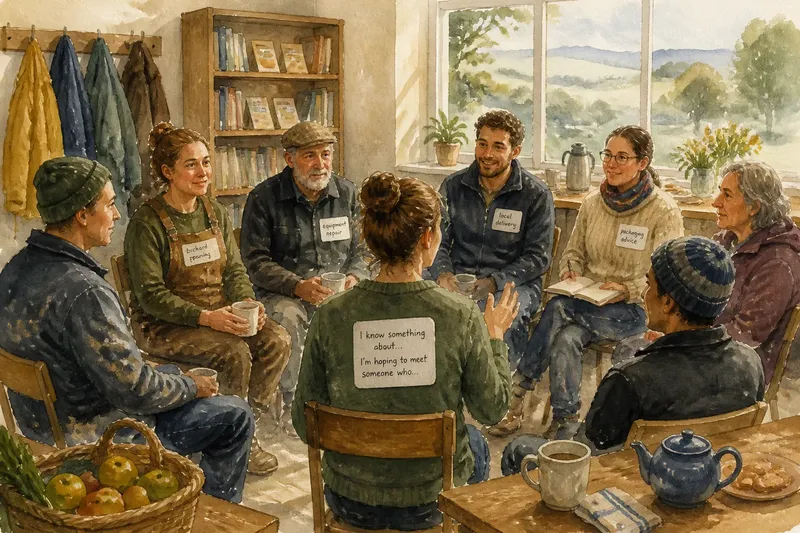
Wet coats hang by the door of a rural library while neighbors settle around a circle of chairs, still carrying the day’s work with them. A well-planned rural networking meeting gives those familiar faces an easy way to share what they know and ask who might help next. It need not feel like a sales pitch or a promise of work.
A clear meeting purpose
Imagine that Mara coordinates a small community orchard and wants to bring local growers, repairers, food businesses, and seasonal workers together. This is an invented situation. She chooses a library people already visit, asks a neighboring village hall to share the invitation, and welcomes anyone whose work touches local food or land.
Mara sets a modest aim: help people learn what others can offer and what kind of connection they seek. She does not promise contracts or solve staffing shortages. Guests may listen without speaking, and no one is asked to reveal private plans.
Before inviting people, she confirms the room layout, accessible entrance, parking or transport details, and whether tea is allowed. Her note says who may find the gathering useful, what will happen, and how to request an access or dietary accommodation. It makes clear that a polished business proposal is not needed.
Invitations that travel
In a small community, one social media post may miss people who do not follow the same pages. Mara asks the library, a farm-supply shop, a growers’ group, and a community employment adviser to share the same short invitation. She also includes people who connect others through their work, such as a bookkeeper or equipment mechanic, without turning the evening into a sales fair.
“Meet people working across local food and land” feels more welcoming than “bring your pitch and make contacts.” The invitation gives guests several ways to take part: bring a question, name a skill, or come to learn who is nearby.
Mara asks only for information needed to plan the room, such as an access request or dietary need. She does not build a contact list without permission. At the gathering, people can choose whether to exchange details directly.
Introductions with a shape
At the entrance, Mara puts name tags and thick markers on a table. Guests can add a few words about their work or interest: “orchard pruning,” “mobile welding,” “local delivery,” or “packaging advice.” These prompts give others an opening without asking anyone to recite a résumé.
For a first round, she offers this sentence: “I know something about ___. I’m hoping to meet someone who ___.” A guest might name a practical skill, a place they know, a service they provide, or something they want to learn. Passing is fine.
Mara introduces herself briefly: she coordinates the orchard, knows the volunteer schedule, and hopes to meet someone who can advise on storing apples after harvest. She leaves out the full history of every project. One useful detail gives others a clearer way to respond.
The prompt also leaves room for informal and seasonal work. Someone who helps neighbors maintain machinery may have no business name; someone looking for paid work may prefer not to announce it to a group. A guest can instead say, “I’m interested in learning who hires for harvest work,” or simply listen.
A gentle meeting rhythm
Mara arranges chairs in a circle, leaves a clear route to the door, and sets tea on a side table. She welcomes everyone, explains the format, invites brief introductions, and leaves most of the evening for open conversation. Late arrivals can join without interrupting a presentation.
She asks guests to share one useful detail and one connection they hope to make, but avoids a timer or bell. If someone speaks at length, Mara can thank them, invite the next person, and suggest continuing their conversation over tea. A calm redirection protects time without embarrassing the speaker.
After the introductions, she asks, “Who might know more about that?” A farm worker might connect someone looking for local timber with a sawmill operator who can explain what is available. The question steers the room toward useful introductions rather than self-promotion.
Formal networking games, rotating pairs, and a presentation deck are not worth the effort unless guests have asked for them. People may arrive after a long shift or need to catch a bus. A clear prompt and unhurried conversation are often easier to join.
Questions hosts ask?
How long should introductions be?
Ask each guest for one detail about their work or interest and one connection they hope to make. If the circle grows large, keep the prompt concise and leave fuller conversations for afterward.
What if someone has no clear request?
They can name a subject they are curious about, a skill they would like to learn, or a kind of work they want to understand. Listening is also a valid way to take part.
Should the host make a contact list?
Only include someone’s details with their clear permission. A simpler option is to let guests exchange contact information directly when both want to continue a conversation.
How can quieter guests take part?
Offer a choice of speaking in the circle, writing a phrase on a name tag, or talking one-to-one over tea. Avoid calling on people unexpectedly, and make passing an ordinary option.
Connections after tea
Say one guest repairs small engines and wants to meet people who need seasonal equipment maintenance. Another coordinates a community garden and knows growers who have asked about repairs. Mara checks that both want an introduction, then connects them; the guests decide whether to exchange details and what to discuss.
The immediate result is a voluntary link between relevant know-how and people who may use it, not a promised job or contract. If they arrange another conversation, that next step is theirs. The meeting has made it easier for them to find one another.
Before people leave, Mara invites anyone who wants to name a next step to do so: “I’ll ask about storage space,” or “I’ll send the repair shop’s name.” A follow-up note can thank attendees and explain how to request an introduction, without asking anyone to report private outcomes.
A worked meeting plan
Imagine Mara has a library room, a small orchard, and invitations ready for local growers, repairers, and food workers. She wants the evening to help people find relevant contacts without collecting personal information. Her choices can be made one at a time:
- She checks whether the room has an accessible entrance, chairs that can form a circle, and a clear way to share transport details. If any need is unmet, she asks the library about an adjustment or changes the venue before inviting guests.
- She asks the library, farm-supply shop, growers’ group, and employment adviser to share the same invitation. If a channel cannot reach the intended workers, she asks a trusted local contact to pass along the note another way.
- She puts name tags, markers, and a tea table near the entrance. If guests need a quieter place to talk, she uses a side area; if the room has no suitable corner, she offers one-to-one conversations outside the circle.
- She opens with the sentence prompt and says that passing is welcome. If a guest prefers not to speak publicly, she offers the option to write a phrase or talk informally afterward.
- She listens for overlapping interests and asks both people before making an introduction. If either declines, she does not share their details and instead looks for another connection they have agreed to pursue.
- She closes by inviting voluntary next steps and sends a brief thank-you note. If guests want another meeting, she asks what format would help; if they do not, she leaves the gathering as a one-time exchange.
The observable outcome is a clear decision at each point: adapt the room, change how an invitation travels, offer another way to participate, or respect a person’s choice not to connect. The plan creates openings without treating attendance or contact exchange as proof of success.
What the host learns
In Mara’s invented evening, the useful features are a specific invitation, a low-pressure prompt, room for listening, and permission before contact details are shared. She can ask afterward which prompt felt natural and whether there was enough time to talk. If guests found the circle uncomfortable, she might offer small-group conversation next time; if the format worked for them, she can keep it.
When planning a rural networking meeting, keep the purpose specific, let people choose how much to share, and make every follow-up voluntary. A useful connection may be one name, one lead, or a clearer sense of who holds relevant knowledge nearby. The host’s last task is to leave people with a straightforward way to continue—or to leave the conversation there.